

電子報內容



TaiwanICDF Overseas Volunteers:Living Meaningful Lives
|
|
|

|
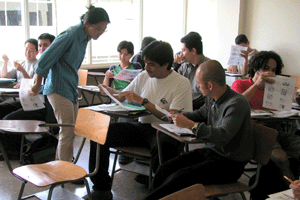
International development cooperation has been a major factor in strengthening bilateral and multilateral relations among nations over the last half-century. The United States established the United States Agency for International Development (USAID) in 1961, while Japan founded the Japan International Cooperation Agency (JICA) in 1974. Both of these are official development assistance (ODA) organizations that are overseen by the governments of those countries. Meanwhile, in 1996, the International Cooperation and Development Fund (TaiwanICDF) was established by Taiwan's government to provide assistance to countries with which Taiwan has friendly relations.
In its inaugural year, the TaiwanICDF set up its Overseas Volunteer Program, in an attempt to encourage increased public participation in international development. Under the program, the TaiwanICDF dispatches skilled volunteers, with a passion for participating in development cooperation work, to partner countries worldwide.
As well as the crucial contribution they make to the economic and social development of Taiwan's partner countries, overseas volunteers play an important role in strengthening relations with these nations and in enhancing Taiwan's image in the international arena.
|
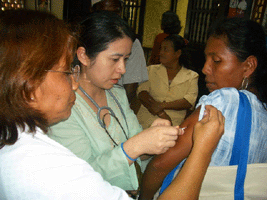
The operations of the volunteer program have significantly contributed to the development drive of partner nations. Volunteers work directly with organizations or communities in these countries. This method of cooperation not only assists the countries directly, but also provides the volunteers with a deep understanding of the culture and customs of the country in which they are based. When they return to Taiwan, the volunteers bring with them invaluable experiences of having worked with people from disparate foreign cultures.
Strong commitment needed
Naturally, a strong commitment is required in working as an overseas volunteer. First, volunteers have to overcome differences in work ethic and attitude. Second, they must adapt to a demanding workplace that may lack facilities or funding. The challenges they face in using their skills in a completely different environment provide an enriching learning experience. To overcome language and cultural barriers, and differences in work methods, volunteers must first establish a bond of mutual trust with the institution for which they provide service. This helps pave the way for volunteers to gradually blend into local society and enables them to serve as partners to locals rather than leaders.
The TaiwanICDF recruits volunteers annually based on the requirements of partner countries. As with the JOCV and the Peace Corps, volunteer programs last two years. The TaiwanICDF shoulders the travel expenses, and provides a living allowance, life insurance, and medical care, while the host country provides accommodation.
|
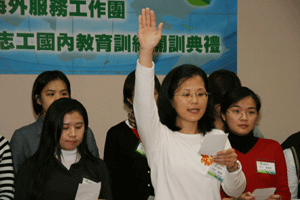
The volunteers take exams that cover language and technical abilities, and must also undergo health checks and personality tests. Those who qualify receive training before their dispatch. Upon arrival in their host countries, they go through adaptation training before being assigned to local organizations.
The TaiwanICDF treats the health and safety of its volunteers as a priority but encourages a spirit of independence. A two-year term is ideal because it enables volunteers to spend their first year adapting to the new environment, learning to speak the language, and getting used to local culture and customs. By the second year, they will have gained enough confidence to work efficiently with their local counterparts.
The organization stresses that volunteers should have a specific area of expertise that can be of practical use in overseas service. Their professional skills make them a vital part of the TaiwanICDF's assistance projects and maximize benefits to host countries.
A variety of volunteer work
|
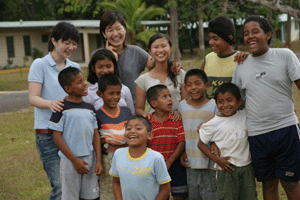
All service operations are targeted at improving the economic and social development of the partner countries. TaiwanICDF volunteers are involved in fields as diverse as health care, education, business development, vocational training, and rural development. The majority of volunteers are dispatched to participate in operations that reflect Taiwan's strengths, with ICT, health care, and education (particularly Mandarin instruction) the focus.
Two examples of successful cases under the volunteer program are the projects with Ciudad del Nino de Panama, and the Tibetan Refugee Self Help Center. The TaiwanICDF established a partnership in 2001 with the former, a private non-profit organization that is partly owned and run by the government. This shelter for poor, homeless, or abandoned infants houses approximately 200 children from 5-18 years old, and provides childcare, education, and nursing aid.
TaiwanICDF volunteers sought to help upgrade the facilities at Ciudad del Nino, so that it could provide better childcare and education services. Volunteers were dispatched to teach computer skills and English, and provide nursing care. One volunteer set up computer facilities and an Internet connection for the charity.
The Tibetan Refugee Self Help Center was established in 1959 in Darjeeling, India. Tibetan refugees established this rehabilitation center as a shelter for their compatriots in India. The main economic activity of the center is handicrafts. The TaiwanICDF dispatched volunteers to offer instruction in Mandarin, computer skills and training in various occupations to refugees at the center. Most importantly, the center urgently required health care services, and TaiwanICDF volunteers assisted in this area.
Short-term Volunteer Program
|
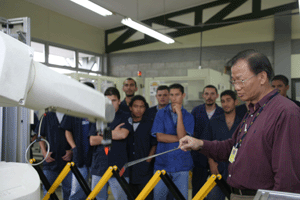
Short-term volunteers began to be sent abroad in 2003, both on a trial and case-by-case basis, and the organizations in partner countries expressed satisfaction with the arrangement. As a result, the TaiwanICDF expanded the scale of its short-term volunteers program, starting in 2005. Short-term volunteers will generally serve a term of 1-3 months overseas. The advantage of this arrangement is that it provides a flexible alternative to interested professionals, expanding the human resource-pool to which the TaiwanICDF has access, while broadening the range of services the organization can offer its partner nations.
One recent example was the Orchid Cultivation Project for Curla University in Honduras, which is well-known for its agricultural accomplishments. TaiwanICDF short-term volunteers demonstrated their professional knowledge and ability in establishing the orchid tissue cultivation techniques with the available facilities and material at the university.
A Boon for Taiwan
Since 1996, the TaiwanICDF has dispatched approximately 262 volunteers to 31 countries. The Taiwan Overseas Volunteers program will continue its efforts to attract larger numbers of qualified Taiwanese who have a passion for providing overseas service, offering them an opportunity to expand their horizons. These individuals will be instrumental in solidifying ties with friendly nations, helping to make a name for Taiwan on the world stage, and working toward the TaiwanICDF's goal of a better world and a brighter future.
* This article is a collaborative work between Taiwan News and the TaiwanICDF.
- Update: 2022/05/11
- Hits:2132