

電子報內容



All roads lead from Rome
|
|
文╱業務企劃處 James Baron |

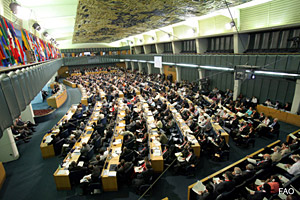
▲Delegates gather in the Plenary Hall at FAO headquarters for the High Level Conference on World Food Security in Rome, June 5. FAO/Giulio Napolitano
|
With the FAO summit recently concluded, many questions still remain about the best way to tackle the current food crisis.
Food security has been spotlighted as an issue on the UN agenda since the FAO launched its flagship Special Programme for Food Security (SPFS) back in 1994 to boost food production in order to fight hunger and malnutrition. Following the 2002 World Food Summit, the SPFS began to focus on establishing national programmes (NPFS). By 2007, a total of 106 countries had participated in the SPFS and nearly half had started moving to NPFS.
Despite this and other commendable initiatives, by the end of last year a combination of factors (including oil prices, population growth, climate change, and growing consumer demand in emerging countries like China and India) had led to a sharp increase in grain prices. Increasing frustration and hunger has led to food riots in more than 30 countries.
With this in mind, world leaders, agricultural representatives, and delegates from around the world gathered in Rome for the three-day conference, with the impact of bioenergy and climate change on food security being billed as the two major talking points.
Widespread disappointment
Unfortunately, participants came away from the talks frustrated by an apparent failure to address either of these key issues in anything approaching a satisfactory manner. Italy's foreign minister Franco Frattini echoed the opinion of many present when he called the final declaration "disappointing" and "watered down," even before it had been formally agreed.
On the former point, Brazil and the U.S., the two largest proponents of alternative fuels were, unsurprisingly, opposed to any review of the issue, with U.S. Agriculture Secretary Ed Schafer insisting increasing ethanol production is "the right policy direction." Brazilian President Luiz Ignacio Lula defended his nation's sugarcane-based bioethanol program but declared himself opposed to the use of other food sources.
Still he dismissed attempts to link rising food prices to the use of biofuels as "smokescreens produced by ..... powerful lobbies," and stressed that attributing the crisis to one factor was a gross simplification of the issue.
As for threat from global warming, the final declaration had virtually nothing new to offer, other than some vague calls to "address the fundamental question of how to increase the resilience of present food production systems to challenges posed by climate change." There was also a reaffirmation of the Mauritius Strategy of 2005 aimed at protecting small developing islands from natural disasters.
But perhaps most disheartening was the lack of any concrete agreement on agricultural aid. The final declaration acknowledged: "There is an urgent need to help developing countries and countries in transition expand agriculture and food production, and to increase investment in agriculture, agribusiness and rural development, from both public and private sources."
It continued by urging donors and development institutions to provide "balance of payments support and/or budget support to food-importing, low-income countries," and suggested debt servicing should be reviewed. Over the course of the conference, US$4 billion was also pledged. But prescriptive measures were, again, ostentatiously scant.
The final recommendation of the suggested immediate and short-term measures was to swiftly conclude the Doha Round and "minimise the use of restrictive measures that could increase volatility of international prices." Lula was more explicit ion this point, contending that "the absurd protectionist policies in the agriculture of rich countries" are most to blame for the plight of the world's starving.
Alternative meeting
These views were strikingly in tune with those voiced at another forum in Rome held by a loose coalition of small farmers' groups, NGOs, trade unions and social activists from around the world. Although groups heading the forum, like the international small farmers' movement La Via Campesina, stressed that the meeting was intended to "parallel" the concerns of the FAO summit, not "oppose" them, the overriding theme was that free-market policies had compounded the current crisis.
"Free trade policies have seriously damaged the food system over time, leading to the food crisis that we're facing today," said Maryam Rahmanian of Iran's Centre for Sustainable Development. She added that using the food crisis to push for even stronger free-trade policies that favor large-scale agriculture was "obscene."
John Hilary, executive director of the NGO War on Want made similar comments in a column for the UK broadsheet The Guardian last week, calling the WTO's push for further liberalization of free-trade tantamount to "tackling knife crime by handing out guns."
And, far from offering a panacea to the problem of rising food prices, the groups at parallel meeting insisted that the Doha Round would compound the predicament of small farmers. In an open letter to WTO Director General Pascal Lamy they stated: "The Doha Round, as is currently envisioned, will further intensify the global food crisis by making food prices more volatile, increase dependence of developing countries on imports and strengthen the power of multinational agribusiness in food and agricultural markets."
Some of the world's foremost development economists have been saying this for years. Jeffrey Sachs has no doubt about the "profound mistake" the IMF and the World Bank made when, during the 1980s and 1990s they took the decision to dismantle state systems that subsidized agriculture and open poor countries up to market forces. No such forces existed, he contends.
Investment in small-scale agriculture
Haiti, for example, once produced most of it's own rice. In the mid-90s, it was opened to imports and inundated with cheap rice from the U.S. It now imports about 80% of its rice. Many other countries, some of which were once self sufficient in rice or grain production (Mexico and the Philippines for example), must now also import most of their food. When prices hit the roof, the world's poorest countries suffer.
What is needed, particularly in Africa, is reinvestment in local small-scale agriculture, particularly fertilizers, irrigation and improved hybrid-seed, says Sachs. He is not alone in advocating direct aid to the world's poorest farmers, particularly those working on two-acres or fewer of land. Nobel laureate Amartya Sen was one of the first to emphasize the importance of small-scale farming in giving developing countries that first foot up the ladder of development.
Still, not everyone agrees with this analysis. Dani Rodrik, a professor of political economy at Harvard, has noted a seeming contradiction in the arguments against the policies of the major institutions over the last two decades:
"I must say that I do not quite understand the argument of those who criticize the earlier liberalization. It seems odd to me to fault the World Bank for advice some 15 years ago to eliminate import protection - so that domestic prices could come down at the time - while at the same time complaining about high prices now, even with the benefit of hindsight. If developing countries had all kept their import protection, the global supply of food today would have been lower, not higher … If you are for self sufficiency, you have to live with high prices."
Sachs and likeminded economists would no doubt respond that, for the world's poorest countries, protective measures need only be in place until sophisticated techniques, technology and inputs had increased productivity enough to allow them to start fending for themselves. To achieve this, they have stressed, it is time the world's rich followed through on their pledges.
Living up to commitments
More than 30 years ago, the UN General Assembly adopted a resolution calling on developed nations to contribute 0.7 percent of their GNI as ODA to the world's poorer nations. A plethora of meetings, summits and get-togethers have reiterated this call, most notably the Monterrey Consensus of 2002, which urged "all developed countries that have not done so to make concrete efforts toward the goal of 0.7 percent of gross domestic product as official development assistance."
At present, only a handful of countries (Norway, Sweden, Denmark, the Netherlands, and Luxembourg) have met this commitment. Most are no way near it.
Many of the factors behind the spiraling food prices - rising demand for meat and dairy products in emerging economies, droughts in high grain-producing areas, and speculative trading in agricultural commodities - are complex and cannot be pinned purely on the policies of richer countries. Most economists agree that the current crisis is the result of a combination of several important factors, some of them difficult to foresee.
However, while richer nations might not be the cause of the food security turmoil, they clearly have a hand to play in its solution. Conferences like the recent FAO summit in Rome are all well and good but to the hungry it is all so much hot air. The world's richest nations must fulfill their pledges now; otherwise they are in danger of making a mockery of the MDGs.
- 更新日期: 2022/05/16
- 點閱次數:763